




Audio and Video record`s URL length can be more than 255 characters.
To make our platform better we are now removing the limit, so URL length can be longer than 255 characters.
 2018-03-30
 220490
To make our platform better we are now removing the limit, so URL length can be longer than 255 characters.
2018-03-30220490
Voximplant now can save audio without compression.
2018-03-15225053
We are happy to announce that video calls that use H.264 video codec can now be recorded. Recorded video calls that use H.264 will be stored as mp4 files (calls with video in VP8 format are stored as webm files).
2017-05-02133215
We chose 48 KHz as the base sample rate for HD audio recorder, since WebRTC/Opus can offer this quality, audio from endpoints with lower sample rate will be re-sampled.
2016-02-04138662
If a call is made in non-P2P mode then its media stream goes via our media servers and we can record it if required.
2015-12-01134016

New integrations for Voice AI have arrived: Google's Gemini 2.0 Flash model, featuring seamless voice-to-voice conversation capabilities and ElevenLabs low-latency streaming speech synthesis are now available for Voximplant developers
2025-03-3185679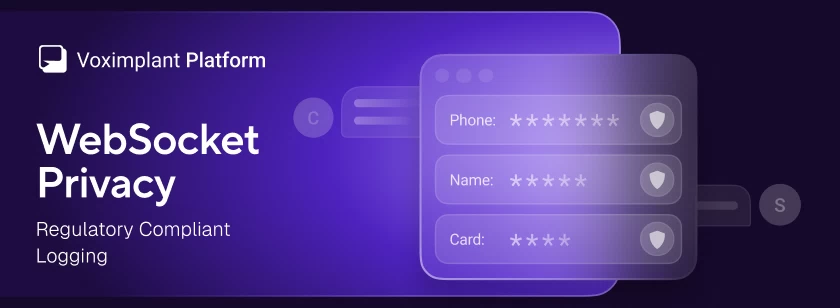
Voximplant has added a WebSocket privacy option that redacts message payloads from logs across all WebSocket-based services – Voice AI connectors and external speech system – and speech control modules
2026-04-23795
OpenAI has recently announced GA version of their Realtime API that Voximplant now fully supports
2025-10-1022495
New Features in Voximplant Kit: Update overview. We are constantly working to improve our product to make it easier to use and more effective for you. In this update, we have added several useful features. Here’s what’s new:
2025-02-1468887
Learn how a Voice AI Orchestration Platform connects LLMs, STT/TTS, turn‑taking, and telephony (PSTN, SIP, WebRTC) to build reliable real‑time voice agents. See benefits, architecture, and how Voximplant helps.
2025-10-277315
Voximplant now includes a native Cartesia Line / Agents connector that connects any Voximplant call to a Cartesia Line voice agent for real-time, speech-to-speech conversations—over PSTN, SIP, WebRTC, or WhatsApp Business Calling—without building custom media gateways or WebSocket streaming infrastructure.
2026-02-116299
Voximplant now includes a native Cartesia module for streaming, low-latency text-to-speech (TTS). You can use a single VoxEngine API to synthesize speech in real time, connect it to any call (PSTN, SIP, WebRTC, WhatsApp) and control playback from a Large Language Model (LLM) or other source, all inside VoxEngine.
2025-11-187112
Voximplant has added Secrets, a dedicated credential store for API keys, tokens, and other sensitive values that VoxEngine scenarios need at runtime
2026-04-27605