When a user connected to an enterprise PBX makes a VoIP phone call to a customer’s landline or mobile phone, the communications protocol has to be converted. In this article, we explain how gateways and SIP trunks enable interoperability between a PBX and the PSTN.
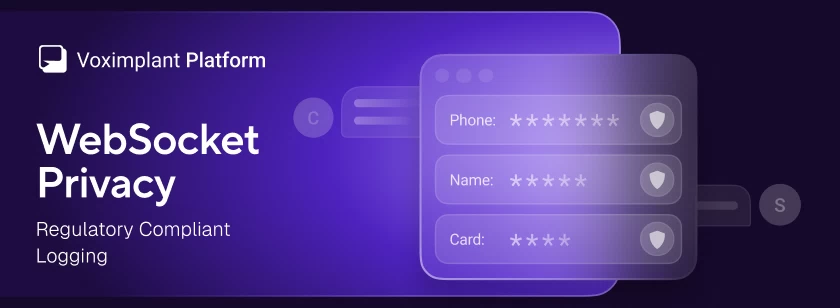
Voximplant has added a WebSocket privacy option that redacts message payloads from logs across all WebSocket-based services – Voice AI connectors and external speech system – and speech control modules
Voximplant has new realtime speech generation for voice AI from Inworld, our latest Voice AI text-to-speech (TTS) partner. Together, we combine state-of-the-art TTS with carrier-grade connectivity so you can build voice agents that sound like your brand, not a generic robot.
Learn how a Voice AI Orchestration Platform connects LLMs, STT/TTS, turn‑taking, and telephony (PSTN, SIP, WebRTC) to build reliable real‑time voice agents. See benefits, architecture, and how Voximplant helps.
Voximplant now includes a native Cartesia module for streaming, low-latency text-to-speech (TTS). You can use a single VoxEngine API to synthesize speech in real time, connect it to any call (PSTN, SIP, WebRTC, WhatsApp) and control playback from a Large Language Model (LLM) or other source, all inside VoxEngine.
Voximplant now includes a native Grok module that connects any Voximplant call to xAI’s Grok Voice Agent API for real-time, speech-to-speech conversations. With a single VoxEngine scenario, you can interact via audio with Grok over phone numbers, SIP trunks and infrastructure, WhatsApp Business, or WebRTC into Grok — all without building custom media gateways or WebSocket streaming infrastructure.




 2020-11-11
 164698